GRADES 2–6 · SCHOOLWIDE CREDENTIAL

Digital Driver's License

Learn it. Practice it. Prove it. Lead with it.

At Cold Spring, students do more than learn how to use technology—they learn how to lead with it. Students in Grades 2–6 earn a Digital Driver's License by demonstrating responsible device care, safe and kind digital citizenship, thoughtful media and AI literacy, and grade-appropriate leadership habits.

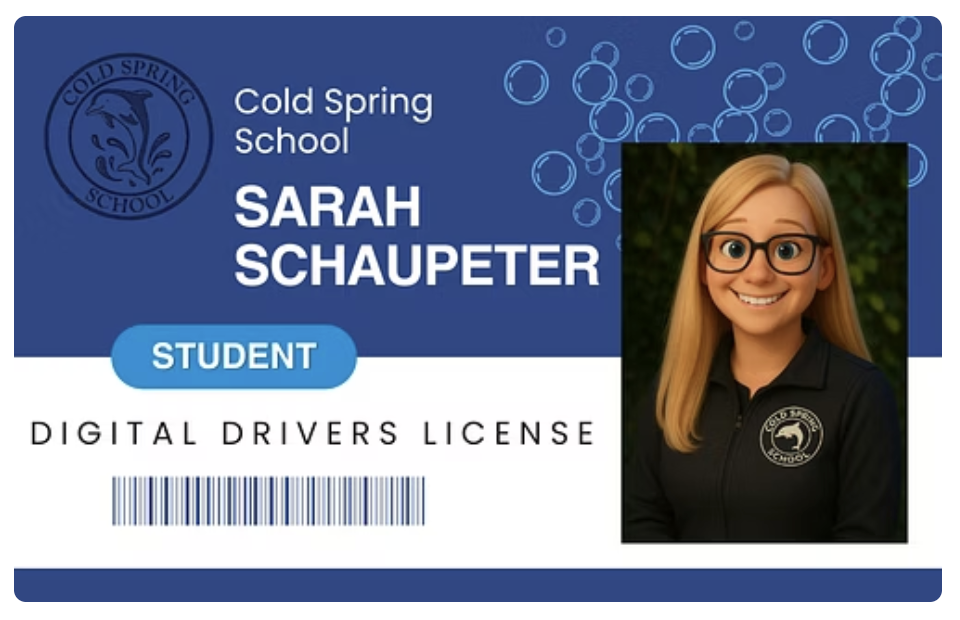
Sample Cold Spring School Digital Driver's License.
Sample credential · For illustration

ONE INTEGRATED COMMITMENT

One License. Four Connected Areas of Responsibility.

The Digital Driver's License is not a separate initiative or an additional curriculum block. It brings together Cold Spring's Leader in Me instruction, Common Sense Media digital citizenship and media literacy, grade-appropriate AI literacy, and daily technology expectations. The three lessons replace three existing leadership blocks rather than adding more instructional time.

  • Device Care

    Students demonstrate safe carrying, charging, storage, workspace, cable, screen, port, battery, and ergonomic practices appropriate to their grade.

  • Digital Citizenship

    Students protect their accounts and personal information, communicate kindly, manage digital conflict, build a positive digital footprint, and know when to seek help.

  • Media & AI Literacy

    Students learn to search safely, evaluate information, recognize influence and design tricks, use AI appropriately, check accuracy, and respect creators.

  • Leadership Habits

    Students apply Leader in Me habits to their choices with devices, digital communication, attention, balance, collaboration, and ethical technology use.

THE LICENSING PROCESS

How Students Earn Their Digital Driver's License

Students complete a three-week instructional sequence during existing leadership time. Each lesson is approximately 25 minutes and includes a mindset connection, direct instruction, guided practice, and a reflection or verification check.

  1. 1

    Learn

    Students learn the grade-level expectations for device care, digital citizenship, media and AI literacy, and leadership.

  2. 2

    Practice

    Students demonstrate the expectations through role-play, classroom scenarios, collaborative activities, and hands-on technology routines.

  3. 3

    Verify

    Teachers use reflection questions, demonstrations, and a final readiness check to confirm understanding.

  4. 4

    Commit

    Students review and sign the Digital Driver's License pledge and agree to the Terms and Conditions.

  5. 5

    Earn

    Students receive their Digital Driver's License during Lesson 3. Expectations are reinforced throughout the year and retaught whenever needed.

Audience
Grades 2–6
Time
Three 25-minute lessons
Setting
Existing leadership instructional blocks
Credential
Awarded after final verification and signed pledge
Follow-through
Reinforced throughout the school year

GRADES 2–6

Responsibility Grows With Every Grade

Students revisit the license each year with increasingly sophisticated expectations. The progression moves from responsible device use and safe searching to source evaluation, digital boundaries, AI ethics, attribution, and digital leadership.

Grade 2

License earned in Lesson 3

Growing Responsibility & Decision-Making

Leader in Me habits

  • Habit 1: Be Proactive
  • Habit 3: Put First Things First
  • Habit 7: Sharpen the Saw

Core competencies

Safe device carrying and charging; clean workspaces; account and password protection; safe searching; digital trails; including others; responding to online meanness; sincere apologies; and device-free balance.

Three lessons

  1. 1Being Proactive with Our Devices
  2. 2Safe Searching & Putting First Things First
  3. 3Super Digital Citizens & Device Balance
View the Grade 2 plan →

Grade 3

License earned in Lesson 3

Digital Life Foundations

Leader in Me habits

  • Habit 2: Begin With the End in Mind
  • Habit 4: Think Win-Win
  • Habit 5: Seek First to Understand, Then to Be Understood

Core competencies

Lid-closed transitions; cable safety; clean workspaces; a Digital Citizenship Charter; Rings of Responsibility; password and identity protection; safe educational gaming; thoughtful communication; conflict resolution; and managing attention thieves.

Three lessons

  1. 1Having a Plan for Hardware & Citizenship
  2. 2Privacy Doors & Win-Win Online Spaces
  3. 3Outsmarting Distractions & Resolving Conflicts
View the Grade 3 plan →

Grade 4

License earned in Lesson 3

Emerging Critical Awareness

Leader in Me habits

  • Habit 1: Be Proactive
  • Habit 5: Seek First to Understand, Then to Be Understood
  • Habit 6: Synergize

Core competencies

Desk, hinge, screen, and port protection; safeguarding personally identifiable information; phishing awareness; S.I.F.T. source evaluation; P.I.E. media purpose; responsible group chats; resisting peer pressure; responding to cyberbullying; and restoring relationships.

Three lessons

  1. 1Hardware Defense & Guarding PII
  2. 2S.I.F.T.ing Sources & Synergizing in Group Chats
  3. 3Upstanders & Restoring Friendships
View the Grade 4 plan →

Grade 5

License earned in Lesson 3

Preteen Digital Life & Boundaries

Leader in Me habits

  • Habit 2: Begin With the End in Mind
  • Habit 3: Put First Things First
  • Habit 7: Sharpen the Saw

Core competencies

Battery and power management; heat and airflow; safe device transport; privacy permissions and tracking; dark patterns and attention design; friends versus followers; invisible audiences; digital reputation; media framing and bias; responsible remixing; and personal digital boundaries.

Three lessons

  1. 1Power Management & Device-Free Moments
  2. 2Privacy Radar & Design Tricks
  3. 3Footprints, Audiences & Responsible Media
View the Grade 5 plan →

Grade 6

License earned in Lesson 3

Increased Independence & Ethics

Leader in Me habits

  • Habit 1: Be Proactive
  • Habit 6: Synergize
  • The 8th Habit: Find Your Voice and Inspire Others to Find Theirs

Core competencies

Ergonomics and strain prevention; port and peripheral care; workspace security; digital identity and online disinhibition; AI evaluation using S.E.E.K.; copyright, fair use, citation, and attribution; resisting the attention economy; de-escalating online harm; repairing harm; and serving as a digital leader.

Three lessons

  1. 1Ergonomics, Workspace Security & Curated Footprints
  2. 2AI Ethics, Fair Use & Synergistic Attribution
  3. 3Navigating the Attention Economy & Digital Leadership
View the Grade 6 plan →

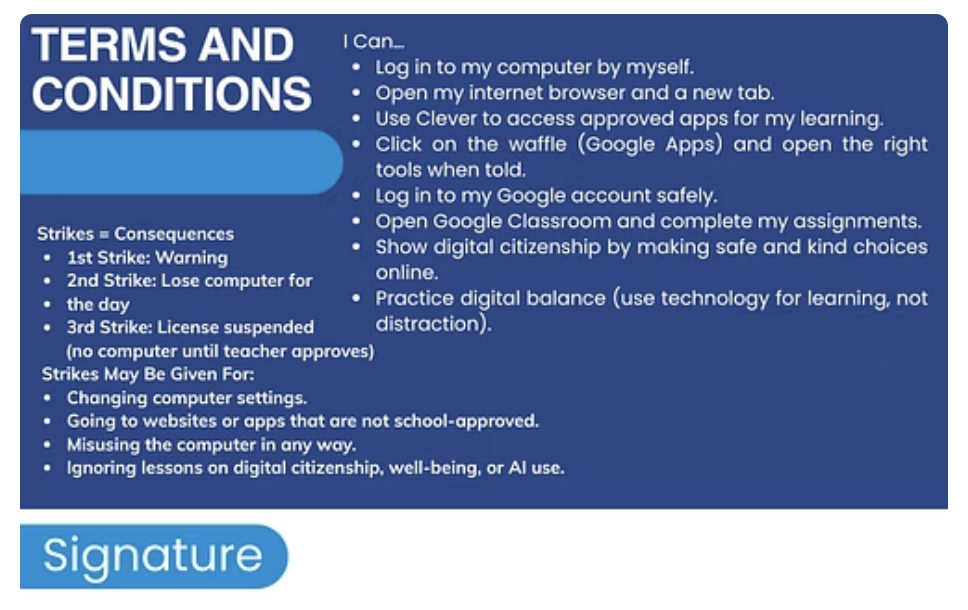
THE STUDENT COMMITMENT

What Students Agree to Do

I can:

  • Log in to my computer independently.
  • Open my internet browser and a new tab.
  • Use Clever to access approved apps for learning.
  • Open the Google Apps menu and choose the correct tool when directed.
  • Log in to my Google account safely.
  • Open Google Classroom and complete my assignments.
  • Demonstrate digital citizenship by making safe and kind choices online.
  • Practice digital balance by using technology for learning rather than distraction.
Terms and Conditions · Select the image to enlarge

Schoolwide Response Sequence

  • First strike: Warning and reminder of the expectation.
  • Second strike: Computer use is paused for the remainder of the day.
  • Third strike: License is suspended until the teacher approves reinstatement.

A strike may be given for:

  • Changing computer settings.
  • Visiting websites or using apps that are not school-approved.
  • Misusing the computer.
  • Ignoring instruction related to digital citizenship, digital well-being, or responsible AI use.

The purpose of the response sequence is to protect learning, safety, and trust. Teachers may reteach expectations, provide additional practice, and verify readiness before reinstating a license.

THE CREDENTIAL

A Visible Reminder of Responsible Digital Leadership

The Digital Driver's License gives students a visible reminder that access to technology comes with responsibility. It recognizes that a student has learned, practiced, and demonstrated Cold Spring's expectations for safe, focused, kind, and ethical technology use.

Sample Cold Spring School Digital Driver's License.
Sample front
Cold Spring Digital Driver's License Terms and Conditions.
Terms and Conditions

Sample shown for illustration. Do not publish student license cards or personally identifiable student information on the public website.

Teacher Implementation at a Glance

Before the Unit

Review the grade-level curriculum, prepare scenario materials, and confirm that students use only district-approved tools.

During the Unit

Teach one approximately 25-minute lesson per week during an existing Leader in Me or leadership block.

Readiness Check

Confirm that each student can demonstrate the grade-level device, safety, citizenship, and leadership expectations.

After Issuance

Reinforce the expectations throughout the year. Reteach, practice, and reassess whenever a student needs additional support.

Frequently Asked Questions

Is this a separate curriculum?

No. The Digital Driver's License integrates Leader in Me, Common Sense Media digital citizenship and media literacy, age-appropriate AI literacy, and Cold Spring's technology expectations into three existing leadership blocks.

How long does the licensing sequence take?

Each grade completes three approximately 25-minute lessons. The expectations are then reinforced throughout the school year.

Do students need to use a new app?

No. Students use only district-approved tools and learning platforms. No new AI or digital tool may be used with students without Superintendent pre-approval.

When do students receive their license?

Students receive the credential after completing Lesson 3, demonstrating the grade-level expectations, and signing the pledge.

What happens if a student is not ready?

The teacher provides reteaching and additional practice, then verifies readiness before issuing or reinstating the license.

How does AI literacy change by grade?

Grade 2 experiences teacher-directed AI instruction. Grades 3–5 move into guided and bounded creation with student authorship and reflection. Grade 6 emphasizes judgment, verification, copyright, fair use, attribution, ethics, and digital leadership.

Ready to Lead Responsibly?

Explore the grade-level plan to see how the Digital Driver's License connects to each student's year-long leadership, digital citizenship, and AI literacy journey.